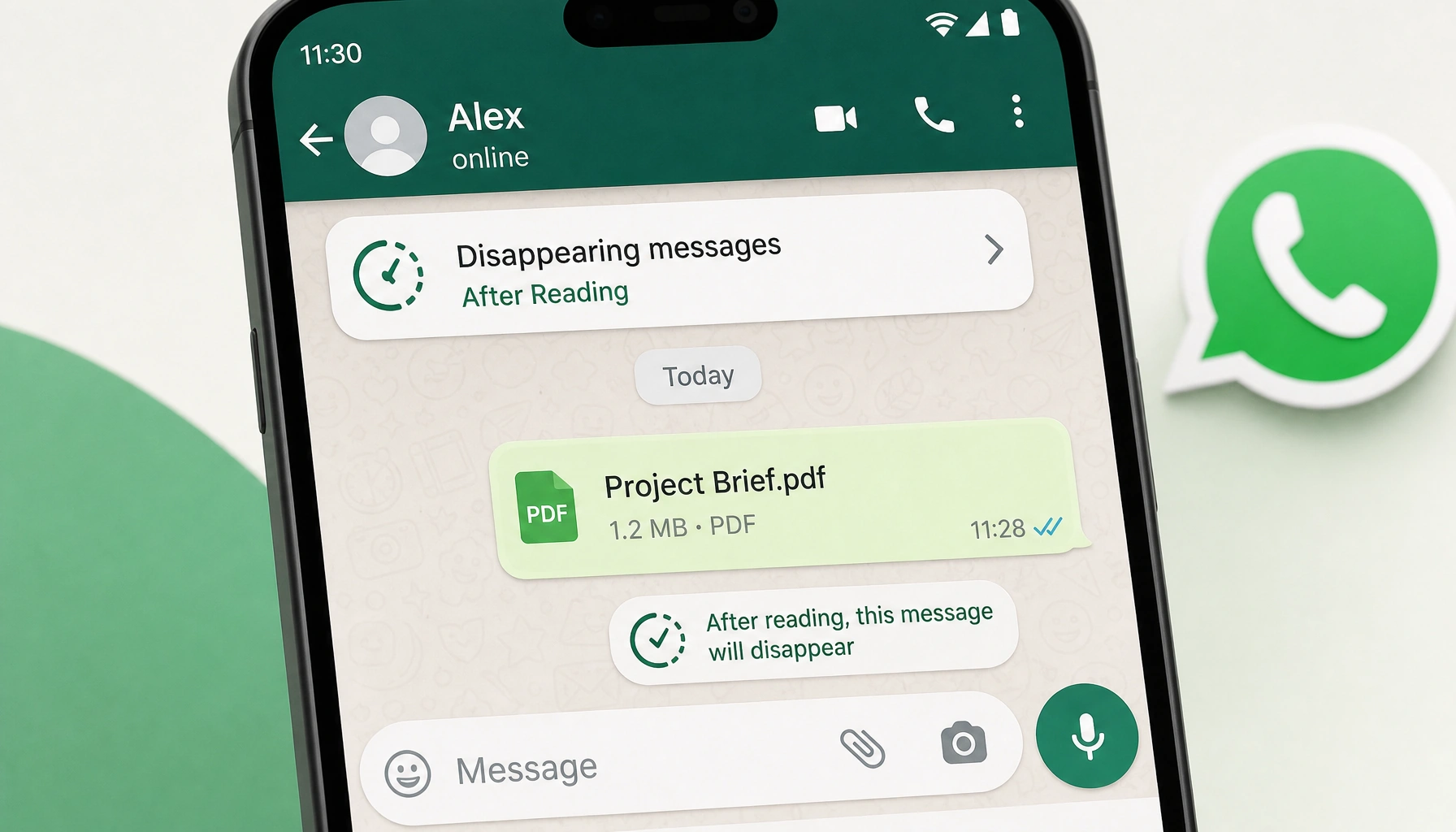
WhatsApp is testing a new disappearing-messages option called After Reading that would delete chats after the recipient opens them. The setting changes the app’s current model, where disappearing messages expire on a fixed countdown after they are sent. The feature is still in development on Android and has not reached beta testers in the clearest preview.
An open-based disappearing timer
The After Reading timer adds a read-based expiry to WhatsApp’s disappearing messages. Instead of starting the clock when a message is sent, the message would disappear after it is opened. That gives users a more direct privacy control over how long a chat stays visible in the thread.
WhatsApp already lets people turn on disappearing messages for chats, but the current setup relies on preset time windows rather than the moment someone reads the message. The new option would sit beside that system and give users another way to decide when a message should vanish.
Android is the first platform tied to the test
The current development work is tied to Android. In the clearest preview, the feature is still under development and is not yet available to beta testers.
That makes rollout timing uncertain. It is also not clear whether WhatsApp will bring the same option to iPhone at the same time, or how the final interface will place the new timer inside the app.
How the new timer sits beside existing disappearing messages
The practical difference is simple: one timer starts when a message is sent, the other starts when it is read. That lets WhatsApp offer tighter control for people who want messages to disappear only after they have been opened.
The feature does not replace disappearing messages altogether. It expands the timing choices available to users who already rely on the privacy setting for shorter-lived chats, while keeping the existing fixed-expiry options in place.
Disclaimer: This article was created with the assistance of AI. Images are for illustrative purposes only.
About the author

Samarth Agrawal is an AI and technology professional who writes about WhatsApp, automation, and emerging AI trends. He focuses on simplifying complex tech updates into practical insights for businesses, creators, and everyday users