
Overview
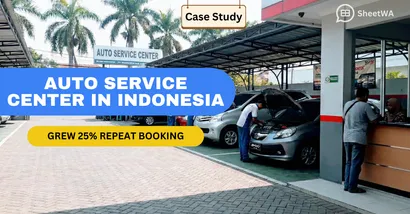
An auto service center in Jakarta wanted to improve customer loyalty and understand client satisfaction more clearly. Although customers regularly visited for routine servicing, the center had very little insight into their experience. Follow-up calls were slow, emails received minimal responses, and handwritten feedback forms were often incomplete.
Customers in the region actively used WhatsApp, which made it the most accessible communication channel. The service center recognised that delivering quick, simple feedback requests on WhatsApp could help them gather honest responses and build long-term loyalty. Using SheetWA and Google Sheets, they created a structured feedback process that encouraged rapid responses and future bookings.
The challenge: Traditional feedback collection methods failed to capture customer sentiment
Collecting feedback had been a long-standing challenge for the center. They had attempted several methods, but most were inefficient.
The key problems included:
low response rate from phone calls
long delays between service completion and feedback collection
feedback forms that were rarely filled properly
difficulty organising responses for analysis
lack of connection between feedback and retention strategies
Without consistent feedback, the team could not identify service gaps or measure customer satisfaction. This also weakened their ability to encourage customers to book their next service promptly.
The solution: WhatsApp requests and SheetWA enabled fast, structured feedback collection

To address these challenges, the center introduced a simple WhatsApp feedback flow using SheetWA. This allowed them to contact customers immediately after service completion with a clear and friendly request.
Read More : How to Send Bulk WhatsApp Messages from Google Sheets
Sending personalised WhatsApp feedback messages
Customers received a message shortly after their service was completed.
Example:
“Hi, your car service is done. How was your experience today? Reply with a rating from 1 to 5.”
The simplicity of the request increased the likelihood of a quick response.
Adding incentives to encourage repeat visits
Along with the rating request, customers were also sent a small discount code valid for their next visit. This created a natural link between feedback and future bookings.
Storing feedback responses in Google Sheets
Every customer’s response was logged into a Google Sheet. The sheet included:
contact details
rating
comments
follow-up status
next service reminder date
This centralised structure helped the team analyse feedback trends and plan retention campaigns.
Using WhatsApp to share review links
After receiving a positive rating, the system sent a follow-up message encouraging customers to leave a review on public platforms. This improved their online reputation and helped new customers discover the service center.
Results: Improvements achieved after implementing the WhatsApp feedback system
Within a short period, the center noticed measurable improvements in customer engagement and retention.
Metric | Before SheetWA | After SheetWA |
|---|---|---|
Feedback response rate | Low | 80% within 24 hours |
Repeat bookings | Unpredictable | 25% booked within 60 days |
Online reviews | Minimal | Significant improvement |
Follow-up effort | High | Reduced dramatically |
Additional observations:
Exceptionally high response rate
The 80 percent response rate within a day was far higher than any previous feedback method. The speed and simplicity of WhatsApp made it easy for customers to participate.
Repeat bookings increased steadily
By sending discount codes along with the feedback request, the center encouraged customers to think ahead. Twenty-five percent of customers scheduled their next service within two months.
Stronger online presence through customer reviews
When satisfied customers were guided to review pages, the center saw a noticeable rise in positive ratings across major platforms. This helped attract new clients and build credibility.
Improved visibility into customer satisfaction
The Google Sheet provided a clear picture of the overall service experience. The team could identify common issues, track satisfaction trends, and adjust their workflow for better service quality.
Impact: Structured WhatsApp communication improved loyalty, retention, and reputation
The WhatsApp feedback loop led to multiple long-term benefits:
faster and more meaningful customer interactions
reduced reliance on slow communication channels
easier follow-up due to organised data
higher retention from incentivised feedback messages
improved brand image through reviews and ratings
This system created a consistent process that strengthened relationships with customers and encouraged timely return visits.
Why SheetWA worked effectively for service-based businesses
The solution was successful because SheetWA:
enabled quick, personalised WhatsApp messages
allowed structured data storage in Google Sheets
reduced manual follow-up work for staff
provided clarity and organisation for feedback workflows
helped the team respond faster and plan better retention strategies
The approach required no new apps, complex integrations, or technical setup. It fit naturally into the team’s existing operations.
Key learnings for automobile service centers and similar businesses
Customers respond faster when messages are short and delivered on WhatsApp.
Immediate feedback requests produce more accurate and honest responses.
Incentives such as discount codes improve repeat booking rates.
Centralised feedback data helps businesses monitor service quality.
WhatsApp can serve as a retention tool, not just a messaging platform.
Takeaway

This case study shows how an auto service center in Indonesia improved customer loyalty by leveraging personalised WhatsApp feedback. Using SheetWA, the center sent quick feedback requests, captured meaningful responses, and encouraged customers to book their next service.
Read More : 13 Real Examples of Successful WhatsApp Marketing Campaigns
WhatsApp became an effective tool for building long-term relationships, improving online reputation, and increasing repeat visits. A simple message delivered at the right time created a powerful loop of feedback, trust, and retention.